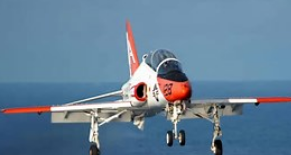
On March 26, 2026, an official document was issued from Naval Air Station Patuxent River, Maryland. NAVAIR (Naval Air Systems Command) confirmed the Final Request for Proposals (RFP) for the UJTS (Undergraduate Jet Training System), a project to replace the aging T-45 Goshawk.
With a scale of approximately 220 aircraft and a project cost of $10 billion, this project has now moved beyond ‘preparation’ and into ‘actual combat.’
1. March 2026: The Countdown to Destiny Begins
With the issuance of this RFP, the entire schedule has been set. Participating companies must submit their final proposals by June 29, 2026, and the U.S. Navy is expected to announce the final winner in early 2027 after approximately six months of rigorous evaluation.
A notable change in this RFP is the relaxation of the ‘direct aircraft carrier landing’ requirement. As of 2026, the U.S. Navy has decided to replace the physical requirement of landing on carrier decks—which demanded extreme structural durability—with advanced simulation and LVC (Live-Virtual-Constructive) integrated training systems. This has created a once-in-a-lifetime opportunity for Korea’s T-50 series, which proposes an already perfected airframe.
2. KAI-Lockheed Martin’s ‘TF-50N’: Why is it the Strongest?
The TF-50N, presented as a ‘One Team’ by Korea’s KAI and America’s Lockheed Martin, is currently regarded as the most likely winning candidate in the market. This is due to three ‘overwhelming strengths.’
① “Already Flying” (Proven Reliability)
The competitor, Boeing’s T-7B, is still struggling with development delays and design revision issues. In contrast, the T-50 is in active service with over 250 units in seven countries, including South Korea, Poland, Southeast Asia, and the Middle East. The U.S. Navy wants a ‘ready-to-deploy asset’ that can be put into training immediately, and the TF-50N perfectly meets this demand.
② ‘Sharing DNA’ with the F-35
Lockheed Martin is the manufacturer of the world’s premier stealth fighter, the F-35. The TF-50N is equipped with a cockpit environment and software similar to the F-35. The fact that U.S. Navy pilots can transition the sensations learned in the trainer directly to the F-35C (the Navy’s stealth jet) is a powerful marketing point that Boeing finds difficult to match.
③ Securing a U.S. Mainland Production Line
The United States places high importance on domestic job creation. Lockheed Martin plans to conduct final assembly of the TF-50N at its Greenville, South Carolina plant. This will be a decisive move to satisfy the ‘Buy American’ stance of U.S. politicians and the Department of Defense.
3. Synergy with LIG Nex1 and Hanwha Aero: K-Defense’s ‘Total Package’
This project is not just a victory for KAI alone. The adoption of the TF-50N means that the cutting-edge South Korean components and weapon systems inside it will enter the U.S. market together.
-
LIG Nex1 (Precision Guided Munitions & Avionics): LIG Nex1’s technology in various Radar Warning Receivers (RWR) and guided weapon interfaces installed in the TF-50N is world-class. In particular, the potential synergy with systems like ‘Poniard (Bigung),’ which recently passed U.S. Navy tests, will accelerate the simultaneous entry of Korean weapon systems.
-
Hanwha Aerospace (Engine & Power Control): The F404 engine, the heart of the T-50, embodies the maintenance know-how accumulated through Hanwha Aerospace’s licensed production. If the U.S. Navy contract is secured, the MRO (Maintenance, Repair, and Overhaul) volume lasting for decades will become a stable revenue source for Hanwha.
-
Hanwha Systems (AESA Radar): A high-performance radar is essential for next-generation trainers. Hanwha Systems’ AESA radar technology, proven through the KF-21 (Korean fighter jet), elevates the TF-50N beyond a simple trainer to a high-value ‘light fighter.’
4. The $340 Billion Butterfly Effect and Global Standards
According to industry analysis, if the U.S. Navy project is successfully secured, the T-50 series is expected to hold an unrivaled #1 position in the global trainer market.
Experts predict that this will lead to more than 1,300 additional exports and an economic ripple effect of approximately $340 billion (340 trillion KRW). This will serve as a decisive opportunity for South Korea to leap forward as a ‘Global Defense G3,’ following the U.S. and Russia.
5. Conclusion: June 2026, The History of K-Defense Changes
The die is cast. From the proposal submission at the end of June to the final announcement early next year, the South Korean defense industry will experience a breathtaking period. Even amid the pain of the 1,510 won exchange rate, the resilience shown by our export companies is a reliable pillar of the Korean economy.
We join the entire nation in cheering for the TF-50N, built with Korean technology, to become the new star of the ‘Blue Angels’ (U.S. Navy flight demonstration squadron) and the KAI-Lockheed Martin alliance.
✅ 3-Line Summary
-
On March 26, 2026, the U.S. Navy officially announced the final bid for the $10 billion UJTS project, signaling the start of a fierce competition.
-
South Korea’s TF-50N is considered the frontrunner, beating out Boeing with its proven performance and compatibility with the F-35.
-
Success in this bid will lead to a historic milestone where the entire K-Defense ecosystem, including LIG Nex1 and Hanwha, enters a massive $340 billion market.